
On the Wildside: A rare beetle disguised as a bird dropping found in city woods
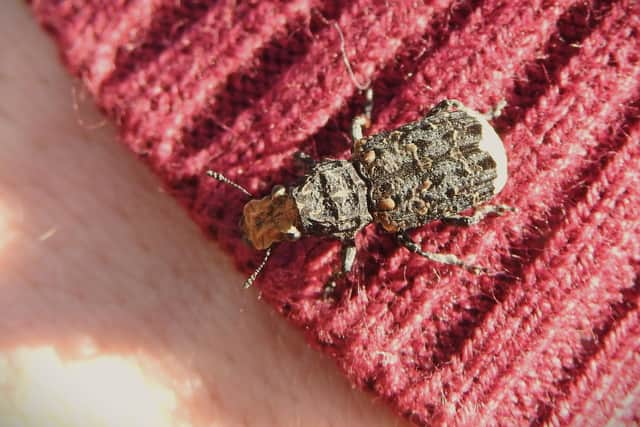
I wrote previously about the importance of ancient trees and associated ‘dead wood’ in local woods, and here is another example. This beetle obligingly landed on the arm of an RSPB volunteer outside the J.G. Graves Discovery Centre, Ecclesall Woods, staying long enough to be photographed.
The insect pictured is Platyrhinus resinosus (scientific name) with various common names including scarce fungus weevil, cramp-ball fungus weevil, and King Alfred’s cakes weevil. It has been described as a truly odd-looking creature that can hardly be confused with anything else. Apparently rather uncommon, Sheffield is on the northern limit of its national distribution, though with climate change the ecological envelopes or niches of many species are widening. The larvae of the scarce fungus weevil eat fungi within dead wood and are especially associated with a fungus I have also written about recently.
This is the cramp-ball fungus (Daldinia concentrica), or more popularly known as King Alfred’s cakes. The beetle seems depend on the presence of this particular fungus, which grows on dead wood, and particularly on beech and ash trees. The adult beetles feed on wood around the fungus with nectar and pollen from flowering trees and shrubs for energy and egg production.
Ecclesall Woods has plenty of dead beech wood because since the 1980s, we began a policy of leaving dead monoliths of beech that had died along with fallen trunks, cut branches, and brash. If you search carefully, the distinctively round, blackened fruiting bodies of the fungus are present throughout the Woods. Other dead wood insects, especially uncommon beetles, are also benefiting from this long-term conservation management of the woodlands, and so this is good news to find the rare weevil. This is one of the reasons why dead wood is left in place, along with the nutrients from the decomposing wood being naturally returned to the soil. The beetle is classed as ‘Nationally Scarce Notable B’ and has a distribution largely from the Severn Valley across the Midlands and then north to South Yorkshire, effectively from the Severn Estuary to the Humber.

Professor Ian D. Rotherham, researcher, writer & broadcaster on wildlife & environmental issues, is contactable on [email protected]; follow Ian’s blog (https://ianswalkonthewildside.wordpress.com/) and Twitter @IanThewildside