
Angle shades moth is a common visitor to Sheffield gardens
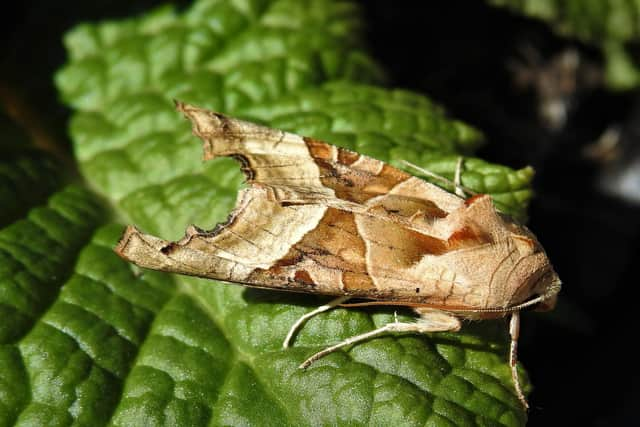
The angle shades moth, a particularly beautiful species, is a medium-sized moth with a wing span of about 50 millimetres.
I remember hatching one of these gorgeous moths from a chrysalis I found in our garden hedge.

I must have been aged about seven and possessed about three old books on insects, illustrated mostly in black and white.
I had no idea what this was going to be and when it emerged I was blown away.

From the markings and shape I found it in my books to be the ‘angle shades moth’ – which I misread as the angel shades and that seemed quite reasonable for something so beautiful.
I don’t think its proper name really does it justice! Its real name actually reflects the angled, dark patterning on its forewings.
The adult moths are generally on the wing in May and June but can turn up in most months of the year.
They feed on the flowers of grasses such as reeds and are drawn to lights and so will turn up at kitchen windows and the like.
At rest, the adults look a little like a withered and wrinkled, autumn leaf – so a good disguise when blackbirds and the like may be searching for tasty tit-bits.
The caterpillars, which are quite fat and generally bright green, feed on a diversity of trees, shrubs and herbs.
These include a range of herbaceous plants such as common nettle, hop, red valerian, broad-leaved dock, and shrubs or trees like bramble, hazel, birches and oaks.
This moth is found in woods, gardens, fens and hedgerows and is both widespread and quite common.
As well as breeding in Britain, this is also a migratory species and flies over from the Continent during periods of settled weather.
Obvious and noticeable and is a common visitor to gardens, it is sometimes found during the day simply resting on vegetation.
Although insect numbers have generally plummeted, 2020 is shaping up to be a pretty good year with plenty of moths and butterflies too.