On the Wildside: The rise of the gadwall duck
A trip to Clumber Park in Notting-hamshire is always guaranteed to turn up some exciting birdlife, and this was no exception. One of the regular sightings there is a duck called the gadwall, apparently derived from or descriptive of the male bird’s ‘incessant chattering’.
The duck makes a quiet quacking noise similar to but quieter than a mallard. The call of the male bird, if quite distinctive, is actually rather quiet, but it is believed that this is what led to the name ‘gadwall’. Indeed, Mark Cocker and Richard Mabey in ‘Birds Britannica’ describe the gadwall as ‘quiet, unobtrusive, and easily overlooked’, and it might be added too, that it was formerly rather rare. In the 1850s there were almost no birds recorded across the whole of Britian, with just two caught in a duck decoy at Dersingham in north Norfolk. There are now over 15 thousand wintering gadwall and maybe two thousand breeding pairs, and so this really is a bird on the up. The original pair of birds caught at Dersingham were captured and given to the Reverend John Fountaine who introduced them to Narborough (at that time, Narford) lake near Castle Acre in Norfolk, where they bred successfully. It was from this modest beginning that the nationwide spread took place. They got to Suffolk by the early 1900s, and the Norfolk Broads soon afterwards. Numbers have been boosted by further releases of captive-bred birds and the species is well-established southeast of a line roughly from the Humber Estuary to the Severn, and an outlying population in Tayside, Scotland.
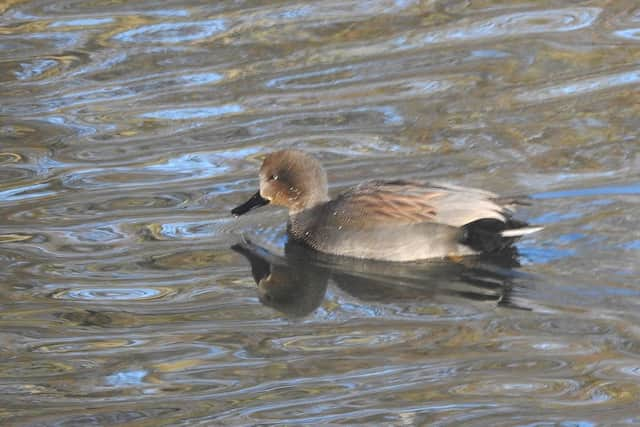
At first sight the drake bird is quite dull with an all-over grey back, and the female is a typically mottled brown duck. However, on closer inspection the markings are subtly pretty with mottling and barring, grey tips to the primary feathers, and a stunningly jet-black rear end. In flight they both display a flash of white on the underwings. Regional sites such as Clumber Park lake are good places to get great close-up views of these once-rare birds and many others too.
Professor Ian D. Rotherham, researcher, writer & broadcaster on wildlife & environmental issues, is contactable on [email protected]; follow Ian’s blog (https://ianswalkonthewildside.wordpress.com/) and Twitter @IanThewildside