
Plans to fine residents for contaminated recycling bins ‘punitive’ says councillor

Opposition councillors have challenged Rotherham Council’s plans to fine residents if they repeatedly fail to sort their recycling into the right bins, branding the scheme ‘punitive’.
One councillor accused the authority of taking a ‘sledgehammer approach’ when drawing up the scheme, which aims to reduce the costs of improper waste disposal and improve recycling rates.
Contamination in household waste bins costs Rotherham Metropolitan Borough Council (RMBC) an estimated £300,373 in additional disposal fees and a loss of £886,299 in recycling income per year.
Under the proposed policy, the council will implement a “traffic light” system to address contaminated recycling bins.
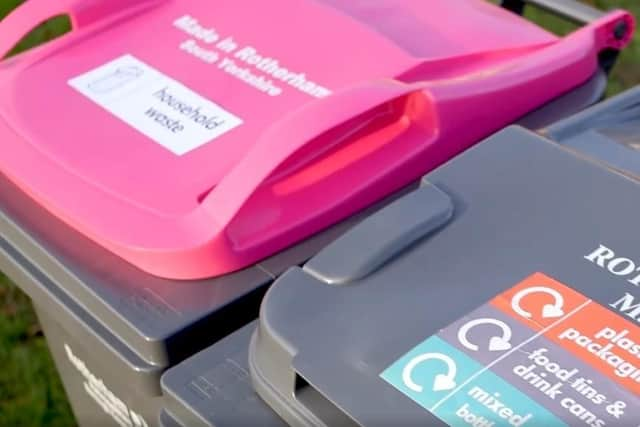

Residents will receive a yellow tag and a warning for the first offence, an orange tag and a letter warning of a potential fine for the second, and a red tag with a potential fixed penalty notice for the third offence.
Fines typically range from £80 to £400, with non-payment potentially leading to a court case and a fine of up to £2,500. Residents disputing a contamination tag will undergo further checks using the council’s waste management software to confirm whether their bin was missed or tagged for contamination.
The scheme was called in for further examination by opposition councillors, after the council’s cabinet agreed to run a public consultation to gather the public’s views on the plans.
Councillors say they are concerned that the fines may be ‘punitive’ to residents, and called for better education around recycling.
Councillor Drew Tarmey, a Liberal Democrat, questioned the need for such a policy, after councillors were previously assured that contamination rates in the borough are ‘very low’.
“Now we’re faced with a policy that is potentially quite punitive,” councillor Tarmey told today’s meeting of the council’s overview and scrutiny management board.
“We’re not satisfied that there’s been sufficient education. We feel that education is the way to solve this, rather than punitive fines.”
Coun Tarmey expressed concerns about the legal challenges of the proposed recycling policy, highlighting difficulties in tracking contamination accurately.
He pointed out the risk of unfairly fining residents if someone else adds non-recyclable items to a bin, or if residents in areas with language barriers or multi-generational households struggle to understand the rules. He emphasized the potential for the policy to unfairly target certain groups.
He added that he believed that the policy is ‘not fit’ to go to consultation.
Councillor Taiba Yasseen, independent, accused RMBC of taking a ‘sledgehammer approach’ with the policy.
Councillor Saghir Alam, cabinet member for finance and safe and clean communities said a fine would be a ‘last resort’, and that the council will work with communities to help with recycling rates.
Sam Barstow, RMBC’s assistant director for community safety and street scene added that data around recycling rates ‘does give a strong basis’ to launch a consultation.
Mr Barstow added that the council’s ‘primary focus’ will be on supporting residents to understand the recycling system, and agreed that “information and communication absolutely needs to be improved to support residents to recycle more [and] reduce contamination’.
“These powers have been in existence for a long time. There are a whole host of different local authorities up and down the country that use these powers in order to effectively manage waste collection.”
A pilot of the new enforcement system will be rolled out across two yet to be announced areas in April 2025, alongside a public consultation.
Members of the overview and scrutiny board agreed that the policy go ahead with assurances from councillor Alam.