
Judge hands Doncaster man 10-year ban after six dogs had to be put down after being kept caged in vans
A Doncaster man was given decade-long animal ban after his dogs were found living in cages inside vans.
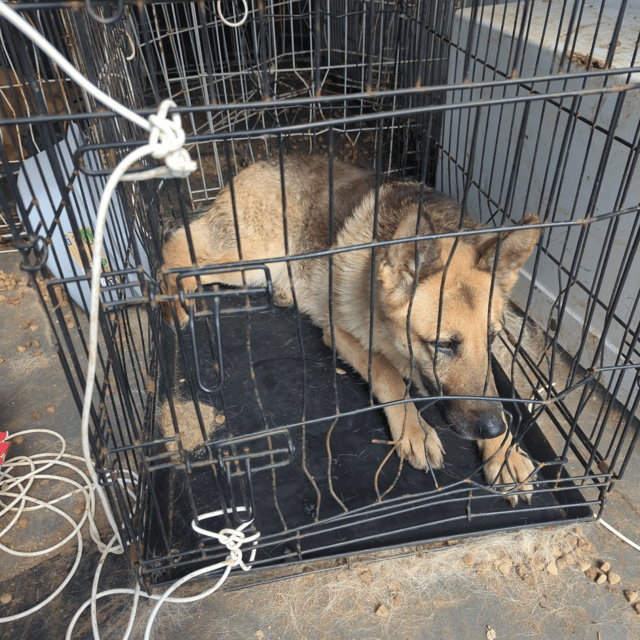
Seven dogs were discovered living in cramped, filthy conditions inside two vans.
One dog made a successful recovery and was rehomed by the charity.

At a sentencing hearing at Sheffield Crown Court (September 9), Ian Welbourn was handed a 20-week prison sentence, suspended for 18 months, and told to carry out 150 hours of unpaid work.
He had pleaded guilty to three Animal Welfare Act offences at an earlier hearing.
The court was told that on June 23 last year an officer from Humberside Police had stopped on land adjacent to the M62 near Goole.
A red van was parked which looked as though it hadn’t been moved for a long time, and as he approached the vehicle he heard dogs barking and became aware of a heavy smell of excrement.
Inside the van were five large German Shepherd/Malinois type dogs in small crates.
There was food on the floor but it was inaccessible to them and none of the animals had access to water.
It was a warm day with the temperature recorded as 23C.
Two small windows were open but there was inadequate ventilation.
Welbourn then turned up at the location in an agitated state and said he had another vehicle close by with a further dog inside.
This van contained a large German Shepherd type dog which was living in the same conditions as the others.
Welbourn was subsequently arrested for an unrelated matter and the dogs were reported to the RSPCA.
RSPCA Deputy Chief Inspector Thomas Hutton, who attended the scene with Animal Rescue Officer Mollie Masters, gave a written statement to the court.
He said: “The five dogs were stacked up on top of each in crates with no obvious water or bedding for them. There was faeces in the base of some of the crates.
“As I removed the second dog I could clearly see she was missing her tail and all that remained was a bloody, black stump.
He continued: “As I removed them further, most had prominent ribs and hip bones with little to no fat covering.”
After securing these animals, he moved on to the second van which held a German Shepard in a similar condition.
The dogs were taken to a local veterinary hospital by the RSPCA where they were certified as suffering by a vet who examined them.
The following day Welbourn disclosed there was a seventh dog living in a separate compartment in the converted green van.
This animal was also removed by the RSPCA and police.
The conditions were so cramped in this separate compartment, that the Malinois type dog was prevented from standing up or moving freely.
He was also significantly underweight with hip and pelvic bones prominent.
A vet who examined the dogs and also gave written evidence in the case said the dogs were all difficult to handle and extremely underweight.
One had a visible head tilt and another was emaciated with wounds to her face and patches of alopecia.
The vet said there was no underlying disease which could have accounted for this dog’s poor body condition.
One of the dogs had to be sedated for his examination which revealed visible muscle atrophy and obvious arthritis.
There was a badly infected bite wound on his left ear and he was tender to the touch over his lower spine, possibly caused by either dysplasia or arthritis.
Magistrates heard that Welbourn had sought veterinary treatment for Elle, the dog with the missing tail, in June 2024 and was told she needed immediate surgery or putting to sleep to prevent further suffering.
Welbourn said he couldn't afford the surgery but would try to raise the finances.
He was provided with three days of emergency medication for her and warned he must return within that time period.
When he didn’t get in touch the vet phoned Welbourn who said he still had no funding and made no further appointment or contact with the vet.
The vet said Elle had been caused unnecessary suffering as a result of her untreated tail injury which had caused her significant pain because of the level of necrosis.
She said any reasonable owner would have sought immediate veterinary advice to prevent infection and followed the advice given.
During an interview with the RSPCA, Welbourn admitted ownership and sole responsibility for the care of the dogs.
He said he had owned the converted vehicles they were found in for two weeks, and they were fitted with air conditioning but it didn't work.
Sentencing Welbourn, the judge said it was clear he was not competent to keep animals due to the dogs’ suffering, on top of his dismissal of professional veterinary advice.
In mitigation the court was told Welbourn, who is currently of no fixed abode but formerly of Doncaster, had mental health issues and had fallen out with his former landlord.
This had made him effectively homeless and he was living in one of the vehicles, although this arrangement was said to be only temporary.
Six of the seven dogs were sadly put to sleep on veterinary advice.
One made a successful recovery and was rehomed by the RSPCA’s York, Harrogate & District Branch.