
Arthur Hutchinson, Dore murders: How triple wedding day killings led to one of Britain's biggest manhunts
What should have been one of the happiest days in the lives of a Sheffield family became one of the darkest in the city’s history, after an on-the-run criminal murdererd the parents and brother of a bride in the hours after the wedding.
This week marks 42 years since Arthur Hutchinson was finally caught and arrested on November 5, 1983 - 13 days after murdering three members of the same family, and raping a wedding guest, at a property in Dore.
Crazed killer Hutchinson struck after escaping from custody after climbing through a toilet window at a North Yorkshire magistrates’ court where he was due to appear having been charged with rape.


While on the run, the fugitive struck at the family home of the Laitners on October 23, 1983, hours after they held a glitzy wedding reception, killing three members of the family and raping a wedding guest at knifepoint.
Hutchinson fled the scene, sparking one of the biggest manhunts in British history.
The crimes
On the evening of October 23, 1983, solicitor Basil Laitner, 59 and his doctor wife, Avril, 55, were winding down after their daughter Suzanne's wedding to Glaswegian optician Ivor Wolfe at a Sheffield synagogue just a few hours earlier.
More than 250 guests had toasted the happy couple in a huge marquee in the garden of the £150,000 luxurious family home in Dore Road, Dore and the couple, along with son Richard and another wedding guest were preparing to settle down for the night after a day of jubilation.
Hutchinson, whose motive was thought to be robbery, had forced his way into the home through the patio door and the first person to be stabbed to death was Richard. Hearing the fracas, Mr Laitner had gone to investigate, encountering Hutchinson at the top of the stairs.

The killer stabbed him three times and then entered the couple's bedroom where despite attempts to resist, Mrs Laitner became Hutchinson's third victim, also knifed to death in a bloody frenzy.
He then turned his attention to a wedding guest, holding her at knifepoint, making her step over the body of Basil Laitner before he tied her up and repeatedly raped her.
Blood from a knee injury sustained when he had gone on the run from police three weeks earlier was found on bedsheets -and would later prove crucial in snaring Hutchinson. Before fleeing the crime scene, Hutchinson helped himself to champagne and cheese - and these would also prove to be vital clues in the hunt for the killer.
The trio of bodies and the distraught wedding guest were found the following day by workers David Wetherall and George Wordsworth, who had come to clear away the wedding marquee.
The murderer
Arthur Hutchinson, now aged 84, was 42-years-old when he committed the brutal crimes which shocked the nation.
Born on 19 February, 1941, in Hartlepool, County Durham, Hutchinson, dubbed himself "The Fox" after evading police for days before his eventual arrest.
He was raised by his mother Louise along with his half-brother Dino Reardon - and from an early age was known for his violent streak.
At the age of seven, Hutchinson reportedly stabbed his sister and, by the time he was in his late teens, he had drifted into petty crime, stealing cars and switching number plates.
He also took to hanging around his home village, armed with a large five foot stick and began acting in a predatory manner around local girls.
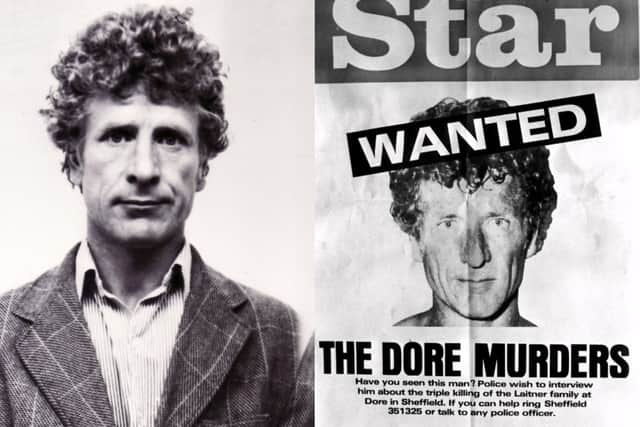
In 1968, after string of relationships Hutchinson settled down and married a local woman - but the marriage was a violent one, with Hutchinson beating and raping his wife on a regular basis.
After the collapse of the marriage, he was convicted of a number of sexual assaults and served five years for carrying firearms and the attempted murder of his brother. He had only just been freed when, in 1983, he was arrested and put in custody for a brutal rape.
However, on September 28 he climbed from a toilet window at Selby Magistrates' Court, slashing his knee on barbed wire and went on the run, avoiding the police by hiding in bushes and gutters and surviving by eating dandelions.
It is thought Hutchinson's motive when he ended up in the affluent suburb of Dore after three and a half weeks as a fugitive was to commit armed robbery of the wealthy Laitner family - but his crime would prove to be far worse.
The victims
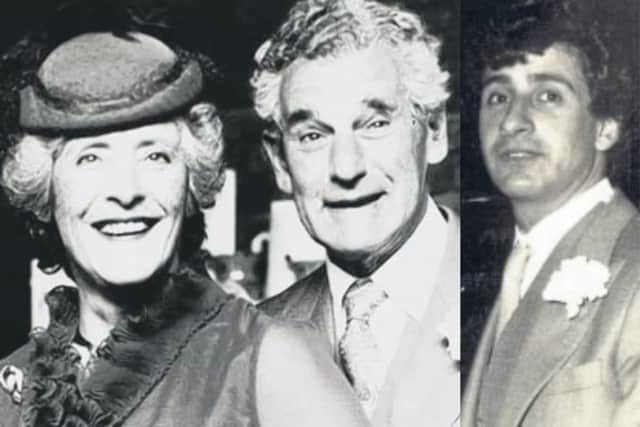
Basil Laitner, 59, was a respected solicitor with offices in Hartshead and a prominent member of Sheffield's Jewish community.
His wife Avril, 55, who had survived cancer, was a popular and respected doctor in the city while the couple's son Richard, 28, a qualified barrister, was also hoping to follow the medical profession.
The wedding guest was the only person in the house who was spared by Hutchinson. Why he spared her after her rape ordeal is unknown.
Her evidence helped to bring Hutchinson to trial.
The manhunt
Hutchinson's identity was quickly established by police thanks to the description given by the wedding guest and scientific evidence the form of fingerprints left on a champagne glass.
An incident room was set up in the village hall in Dore and police forces across the country were put on alert.
It emerged that, after his escape in Selby, he had been treated at Doncaster Royal Infirmary October 2 and 4 for his injuries.
Following the murders on October 23, he stayed in the Carlton Road guest house in Worksop the following night and a week later was spotted drinking in The Drum pub in Bentley, near Doncaster.
He also moved from place to place - from Barnsley, Nottinghamshire, Manchester, York and Scarborough -and used disguises to alter his appearance.
It was during this time he gave himself the nickname The Fox, using the name in a letter sent to the Yorkshire Post. Police also took the unusual step of releasing his photo - and his mugshot was splashed on the front pages.
The trial
A trial at Durham Crown Court heard he stabbed Richard Laitner with a Bowie knife as he lay in his bed.
When Basil Laitner went up to investigate Hutchinson turned the knife on him, leaving him slumped on the staircase.
Hutchinson then found Mrs Laitner cowering in a bedroom.
She tried offering money to make him leave, but he killed her too after a long struggle.
He boasted of his cunning and claimed the authorities would never catch him. While a fugitive, he wrote to and telephoned The Star’s sister title, the Yorkshire Post.
He was eventually captured by police in woods close to his home town of Hartlepool.
He denied all the charges he faced.
Hutchinson’s whole-life tariff and unsuccessful appeal
In an appeal lodged heard in January 2018, triple-killer Hutchinson had claimed that his whole-life term amounted to inhuman and degrading treatment as he had no hope of release.
But judges found there had been no violation of Article 3 of the European Convention on Human Rights.
The Grand Chamber of the European Court of Human Rights (ECHR) concluded that whole-life sentences in the UK can be regarded as compatible with the article, which says no-one should be subjected to inhuman or degrading treatment or punishment.
The judge in his original trial ruled that he should serve a minimum of 18 years but then home secretary Leon Brittan later ruled he should face the whole-life tariff.
In 2008, Hutchinson had a domestic appeal against whole-life tariffs dismissed by the Court of Appeal.
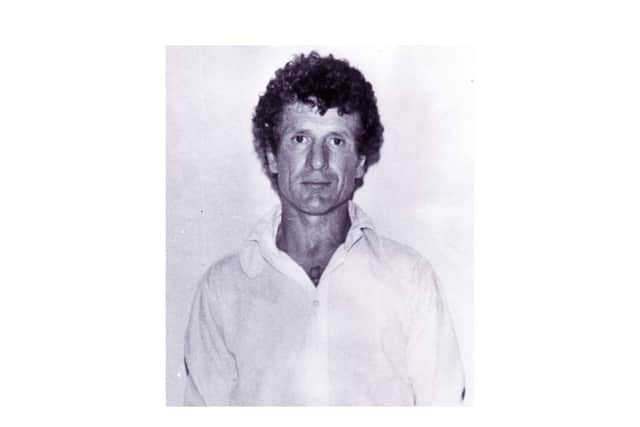
Then in 2015, the European Court of Human Rights threw out his case. But Hutchinson applied for his appeal to be passed to the Strasbourg court’s Grand Chamber.
The 2018 ruling followed a protracted legal saga over the issue of ‘life means life’ prison terms, under which there is no minimum term and the individual is never considered for release.
In 2013 human rights judges found the power to release a whole-life prisoner was unclear in a judgment that raised questions about the sentences.
But in a later ruling on Hutchinson’scase, the ECHR found there had been no violation, saying doubts concerning the release power had been addressed.
And in the 2018 judgment, the Grand Chamber held by 14 votes to three there had been no breach.
Whole-life prison terms
As of March 31, 2025, there were around 70 whole-life prisoners who will never be released, including Hutchinson.
Other whole-life prisoners whose crimes brought them into and around South Yorkshire include the notorious child killer Damien Bendall.
In December 2022, Bendall was sentenced to a whole-life order after he admitted to murdering his partner Terri Harris, her children John Paul Bennett and Lacey Bennett and Lacey’s friend, Connie Gent, after an horrific incident at their shared home on Chandos Cresent, in Killamarsh, in September 2021.
Bendall also admitted raping 11-year-old Lacey during the rampage.
In 2015, Ian Birley was given a whole-life term after murdering 65-year-old John Gogarty at the OAP’s Wombwell home, while on licence for an earlier murder.
Birley had been let out on licence just 18 months before he killed Mr Gogarty for the 1995 murder of pensioner Maurice Hoyle, who he also killed in his own home in a sustained attack.
In 1989, killer Anthony Arkwright was sentenced to a whole-life tariff for a 56-hour killing spree in which he disembowelled three victims in Wath-upon-Dearne, Rotherham.
He was sacked from his job in Mexborough then went home and stabbed his grandfather and two of his neighbours.