
Harvey Willgoose trial: Sheffield schoolboy accused of murder questioned about bullying
A teenage boy accused of murdering 15-year-old Harvey Willgoose in a Sheffield school stabbing has faced questions over whether he has ever bullied fellow pupils during the fourth day of his evidence to jurors.
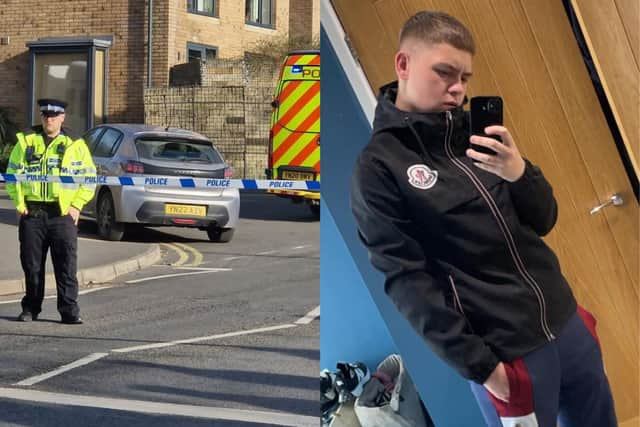
Harvey was stabbed in the heart in the courtyard of All Saints School a few minutes into the lunch break on February 3, 2025. He collapsed less than a minute later, and died a short time after that.
A teenage boy, who was a pupil at the same school as Harvey, has been on trial at Sheffield Crown Court for the last three weeks accused of murder, which he denies.
The defendant, who cannot be named for legal reasons, has admitted to carrying out the stabbing, to Harvey’s manslaughter and to possessing a bladed article on school premises.

He has previously described the years of bullying he has experienced throughout his time at school, with much of the abuse focused on his appearance and a medical issue. The defendant said that - along with difficulties in his home life - has led to him developing anger issues he cannot ‘control’.
After completing his evidence-in-chief with questions from lead defence counsel, Gul Nawaz Hussain KC, earlier today (Tuesday, July 22, 2025), the defendant then faced questioning from prosecutor Richard Thyne KC.
“Did you use a lot of violence towards students?”
Referring to records held by the defendant’s previous school, Mr Thyne asked the boy about instances of alleged violence and bullying.
“Did you use a lot of violence towards students at [your previous school],?” asked Mr Thyne.
The defendant replied: “Not on purpose or intentionally.”
Mr Thyne continued: “I’ll ask again, did you use a lot of violence towards students?”
“Not a lot,” said the defendant.
Mr Thyne took the defendant through entries in his record, in which either students or staff have described his behaviour as ‘bullying’.
One such incident is alleged to have involved three other pupils, in which the victim was hit multiple times and held down so others could hit him. It was also filmed.
"Did you and a group jointly attack [a school pupil]? The defendant replied: "It wasn’t a group."
"Do you agree that happened?" the prosecutor asked.
He boy replied: "Yeah."
"How many people were involved?” asked Mr Thyne.
The defendant replied: "Two."
"There’s you, there’s [a male pupil, female pupil and a second male]," continued Mr Thyne.
The defendant replied: "No."
Asked Mr Thyne: "So it wasn’t filmed?"
The defendant replied: "It was filmed."
The boy accepted he had previously received a school sanction for kicking another pupil in the stomach.
He was asked questions about him repeatedly targeting another pupil and 'kegging' him, which, he explained, means pulling his trousers down.
"He kegged me and I kegged him back," responded the defendant.
The defendant was also asked about another incident during a P.E lesson, described as bullying by the school, in which a pupil claims the defendant pushed him into fencing.
“I shoulder barged him in football into the astroturf,” said the defendant in response to questions about the incident.
Asked Mr Thyne: “So you did do something?”
He replied: “I was playing football, on astroturf, and I shoulderbarged him into the fence.”
Mr Thyne then referred to a record from a teacher who asked the defendant about the incident, in which he is alleged to have denied doing anything despite the ‘red marks’ on the face of the boy involved, before becoming angry and throwing a chair.
“Did you say you hadn’t done anything?” asked Mr Thyne.
“Yeah,” the defendant replied.
“Did you throw a chair across the corridor?”
The defendant replied: “Yeah.”
Mr Thyne continued: “Were you repeatedly kicking other students in a P.E lesson?”
The defendant responded: “It’s not kicking, it’s called snapping.”
“So is that [record] wrong?” continued Mr Thyne.
“Yeah,” said the defendant.
Defendant asked if had ever hit a sibling for ‘no reason’
The defendant was also asked whether he had ever hit a sibling for ‘no reason,’ and referred to a report the sibling had made about the defendant hitting them every day.
The defendant denied hitting them every day.
“Did you hit [them] without reason?” asked Mr Thyne.
He replied: “This when I was young. If [they] annoyed me, I’d hit [them].”
The defendant then added: “Not hard though.”
Mr Thyne also referred to a record from December 2024, two months before the fatal stabbing, in which the defendant’s sibling referred to him being ‘aggressive’ at home, and frequently hitting them and ‘taking everything out’ on them.
“Is that true?” asked Mr Thyne.
Replied the defendant: “The only reason [they] cried was to get out of that detention.”
Mr Thyne again asked the defendant if the claims made by his sibling ‘were true’.
‘No,” replied the defendant.
“[They] say you were aggressive,” continued Mr Thyne.
The defendant replied: “I was aggressive but I wasn’t hurting anyone.”
History with knives
Mr Thyne also asked the defendant about his history with knives.
“On Friday, you agreed that when you killed Harvey that wasn’t the first time you took a knife into school,” Mr Thyne said, and referred to images taken from the defendant’s phone in which he is seen pictured with a blade in a wooded area of the school.
Mr Thyne added: “When you were first interviewed by police you didn’t mention being on school grounds with a knife before.”
“I can’t remember, I don’t think it was asked to me,” the defendant said.
In response to questions as to whether he would have characterised his decision to bring a knife into school on that day as ‘something unusual’ when speaking with the police, the defendant replied: “I can’t remember.”
“Can you really not remember being in school with a knife before?” Mr Thyne asked.
The defendant replied: “No, because that’s not what I was focused on.”
Mr Thyne referred the defendant to reports prepared by a psychologist and a psychiatrist, both of whom said he had denied bringing a knife into school prior to the fatal incident.
Mr Thyne said: “Tell the jury why you lied please,” to which the defendant replied: “I didn’t lie, I just didn’t remember.”
“This isn’t a case of you not remembering because you told both of those doctors you didn’t do it…I’m asking why you told that lie?” continued Mr Thyne.
The defendant replied: “Because I didn’t remember.”
“You don’t remember saying it or don’t remember bringing a knife into school?” asked the judge, Mrs Justice Ellenbogen DBE.
Replied the defendant: “At the time they asked me I didn’t remember bringing a knife into school.”
The defendant agreed he had been ‘interested’ in knives, and said he could not remember if that was before or after he became a pupil at All Saints.
Mr Thyne also asked the defendant about a school record which suggested he had used ‘inappropriate language,’ in that he talked about ‘stabbing up’ a pupil while holding a craft knife.
“I can’t remember because it was two years ago, and if I did say it I wasn’t being serious,” said the defendant.
When asked why he ‘would say words like that,’ the defendant replied: “Either banter or because they said something to me.”
The defendant also said a record, in which he is alleged to have told a fellow pupil he would ‘shank them after school,’ was ‘wrong’.
Answering questions about other pictures of knives found on his phone, the defendant said a picture of a ‘zombie knife’ was not taken at his home address, and said he knew that because he had never owned that type of knife.
The defendant said he believed the photograph of the knife must have been taken by someone else.
“Although that looks like part of your house, and although you’ve searched for rambo knives, and although it’s saved on your phone you don’t know where it’s come from?” asked Mr Thyne.
He replied: “I do know where it’s come from…I accidentally saved it from someone who’s sent it to me.”
The defendant’s cross-examination is expected to continue tomorrow.
The trial continues
The defendant previously pleaded guilty to charges of manslaughter and possessing a blade on school premises.
He denies murdering Harvey.
The trial continues.