
'Sheffield broke temperature records for May twice during scorching 31C Bank Holiday Weekend heatwave'

Last weekend’s scorching Sunday was hottest for May since 1947
Sheffield saw its hottest day in May in 100 years over the Spring Bank Holiday weekend.
Scorching Bank Holiday Monday (May 25) saw temperatures climb to a peak of 31.8C, according to the Weston Park Museum weather station.
This made it the hottest recorded day in May, shattering a record of 29C - which had stood since 1947.
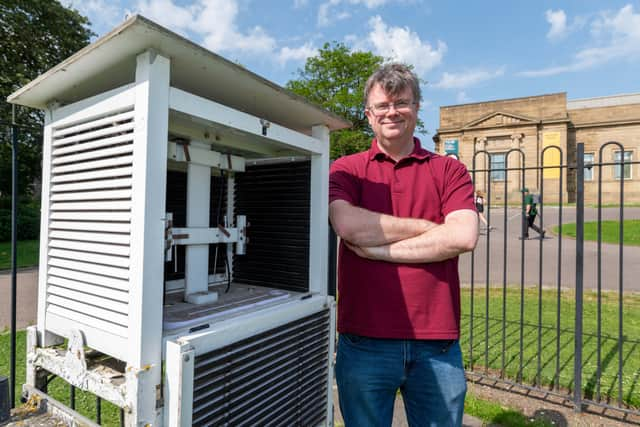

That evening also set the weather station’s record for warmest night in May, with a minimum temperature of 17.4C logged.
“That is just that Monday,” said curator of the Weston Park Museum weather station, Alistair McLean.
“We have been breaking temperature records at an alarming rate, and in the past decade most temperature records have been broken.
“The warmest temperature on record was absolutely shattered in an alarming fashion in 2022, with 38.9C.
“For the most of my career the record temperature was set in 1990 with 34.3C. A new record has been set three times since 2020.”
Meanwhile, it comes as Sheffield and much of the UK is forecast widespread heavy rain on June 1 and into the weekend.
Weird weather in Sheffield
Two more interesting weather events took place on May 26.
First, before the 31.8C record was set, the temperature hit 31.6C - which would also have broken the 1947 record, had the mercury not continued rising.
Second, the city saw a ”cloudburst” on May 26, where extremely isolated pockets in the southern regions of Sheffield saw rain fall at a rate of more than 32mm an hour.
However, while this fell, there was often no rain recorded at all in neighbouring districts. Residents in Highfield and Meersbrook saw severe heavy rain at the same time as areas like the city centre remained dry and hot.
‘Particularly weird’
Since 1997, Alistair McLean has been the curator at the Weston Park station, which is associated with the Met Office and has records dating back to 1882.
After nearly 30 years, Alistair describes Sheffield’s weather as “particularly weird.”
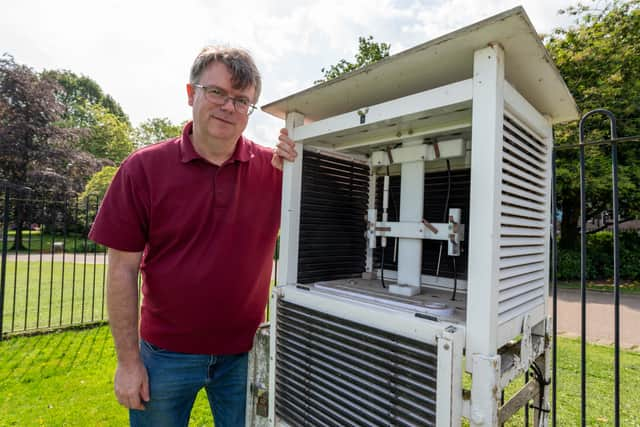
“It’s surprisingly common in Sheffield where we’ve not recorded a drop in Weston Park but it will rain very hard somewhere else in the city,” Alistair told The Star.
As another example, despite the drought in 2025 that saw reservoirs drained to stock levels of just 30 per cent, it was the second year in a row Sheffield saw more rain year on year, with 2026 on track to be another of these.
“We are getting slightly more rain year on year,” said Alistair. “But we are seeing more cloud burst events with lots of rain all in one go which can cause flash flooding.
“Despite this, 2025 was a dry year - not especially dry, but dry.
“If you look at rain records over decades, there are peaks and troughs, and I think Sheffield is due a dry year.”
Of course, Sheffield’s rain records were set in June 2007 when a flood claimed the lives of two people.
Alistair, also a zoologist, notes that one way Sheffield has been directly affected by climate change can be seen along its rivers - by looking at its dragonflies.
“As conditions get warmer and winters get milder in the north, we’ve seen the number of dragonflies triple.
“It may sound like a good thing, but it represents species moving into the area that weren’t here before, and where do the things that were here before go?
“It’s been very, very difficult to make things fair between environmental devastation and all the people who need food and energy.
“And we’re having catastrophic impact on the planet that does result in extinctions.
“As far as temperatures are concerned, the records of 2020 will take some beating - and if we were to break 38C in the next few years we would be very alarmed, because if so then that’s the kind of temperatures we can continue to expect. They would no longer be anomalous. But time will tell.”