
Architect's love letter to Sheffield - the 'city with a dual soul'
“Living cities are layered,and Sheffield embraces this layering without fear.”
In this love letter to Sheffield’s ability to blend the past with the present, architect Antonio D’Onofrio shares his appreciation for the city centre’s “almost seamless” transitions between Victorian elegance and the modern world.
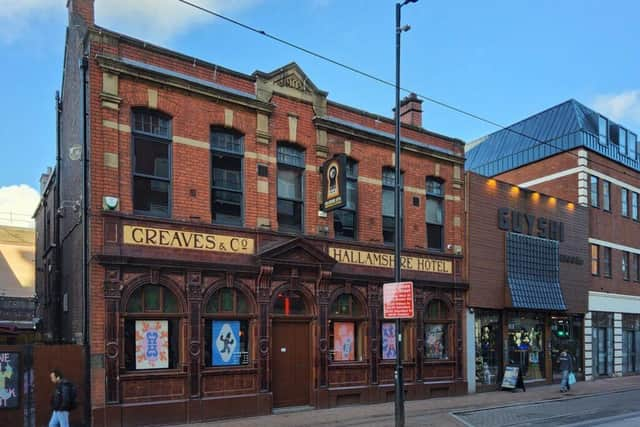

Sheffield is a city with a dual soul. Walking through its centre, you immediately sense how the urban fabric alternates – almost seamlessly – between elegant Victorian buildings and industrial structures transformed into modern constructions with bold architectural vocabularies. It is a city that has chosen neither to erase its past nor to remain imprisoned by it: instead, it allows memory and innovation to coexist, and in this tension it finds its most authentic identity.
The historic buildings speak of the era when Sheffield was an industrial powerhouse. The Town Hall, with its decorative late-nineteenth-century architecture, is a civic manifesto that evokes a time of faith in progress and strong municipal pride. Endcliffe Hall, with the monumentality of Victorian private residences, reflects the wealth of an industrial bourgeoisie that built houses as symbols of economic and social success. And then there are sites like the Abbeydale Industrial Hamlet, precious witnesses to a manufacturing past that not only shaped the landscape but quite literally built the city and its culture.
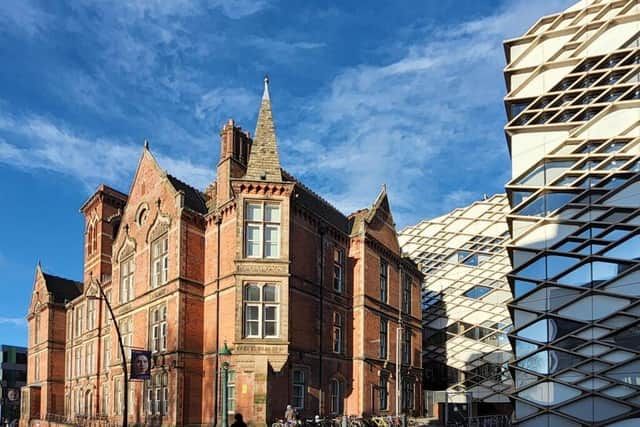
Alongside this heritage stands a new Sheffield, aware that the architectural language of the twenty-first century must speak of sustainability, research, and transformation. In this sense, the role of the University of Sheffield is crucial: many of the most interesting contemporary buildings emerge from the campus itself.
The Diamond is the most emblematic example. Completed in 2015 as a hub for the Faculty of Engineering, it is a building that neither tries to blend in nor to impose itself arrogantly. Its geometric façade, inspired in part by traditional local architectural motifs, creates a balance between modernity and its urban surroundings. Inside, flexible spaces, laboratories, and study areas demonstrate how contemporary functionality requires new forms, new ideas, and new relationships with light and comfort.
The Winter Garden, with its large timber-and-glass structure, represents yet another direction in modernity: the need to bring nature and environmental quality into urban life. It is not merely a formal exercise, but a social gesture – a symbol of welcome and openness. Buildings such as the Arts Tower or the Western Bank Library, instead, recall the modernity of the post-war period: clean lines, glazed surfaces, rational volumes. These buildings form a temporal bridge between industrial Sheffield and its contemporary counterpart.
As an architect, what I find most fascinating is precisely the dialogue – at times harmonious, at times more conflictual – that arises between these worlds. Living cities are layered, and Sheffield embraces this layering without fear.
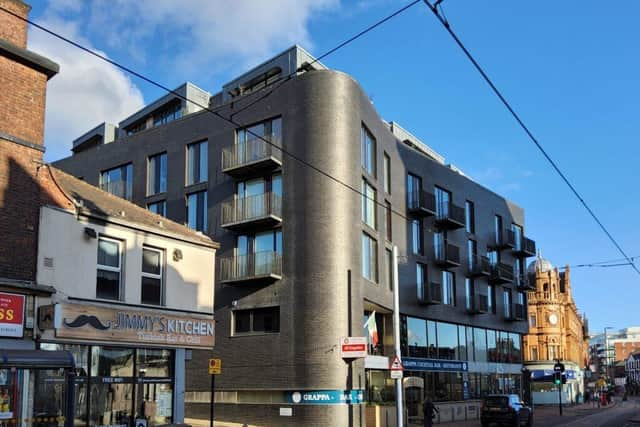
The risk, as always, lies in excess: a contemporary building that is too self-referential can disrupt the urban balance, while overly rigid preservation can prevent growth and innovation. Here, however, one perceives a constant effort at mediation: whether through the reinterpretation of historical patterns, the adjustment of scales, or the use of materials that echo local traditions, the city seems intent on cultivating continuity, even as it accepts a changing face.
Ultimately, Sheffield’s strength lies in presenting itself exactly as it is: a city that carries the marks of the nineteenth century on its skin while boldly projecting itself toward the needs of the present. The simultaneous presence of historic buildings, urban parks, and contemporary architecture such as The Diamond is not a contradiction but a narrative of identity. And perhaps this is what is most captivating: not formal perfection, but the sincerity of a city that grows without forgetting what it has been.
This article originally appeared in both Italian and English on Mr D’Onofrio’s website at: https://www.adstudiodonofrio.it/sheffield-dove-il-passato-incontra-il-futuro-dialoghi-architettonici-in-una-citta-che-cambia