
Wildlife: The unobtrusive Gadwall Duck
One of the ‘dabbling ducks’ and a cousin of the very familiar wild Mallard Duck is the Gadwall which is described as ‘quiet, unobtrusive, and easily overlooked’. From its overall appearance, they are often simply known as the ‘Grey Duck’.
Viewed close-up, the male drake is a surprisingly pretty bird, with overall a speckled grey flank and back, and a distinctive jet-black bottom.
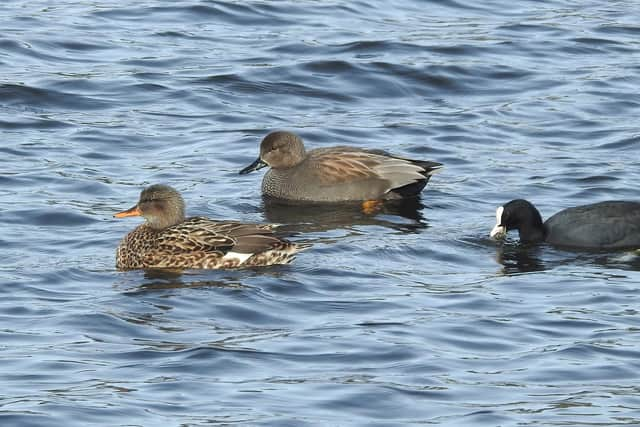

The female has brown plumage and characteristically orange-yellow edges to the bill which are absent in the male; the bill of the latter being black.
Both males and females have a white wing speculum visible in flight, and the latter is fast and direct.
The males whistle and grunt, whereas the females tend to quack, but overall, they tend to be both shy and quiet.
The picture was taken on one of the artificial lakes at Newstead Abbey in the Dukeries, and it seemed that pairs of Gadwall were interacting with local Coots.
Whilst Coots can be very aggressive, this appeared to be perfectly amicable and quite difficult to interpret what was happening. However, it is known that Gadwall do steal food (plant materials) from Coots, a strategy known as kleptoparasitism whereby they wait for another species to collect foodstuff and then they nick it which saves energy otherwise expended in collection.
Overall, they are mostly herbivorous and feed on submerged aquatic vegetation such as pondweed and algae.
They eat greater quantities of leaves and stems than do the other dabbling ducks like Teal and Mallard.
The Gadwall is indeed easily unnoticed and especially if out on open water as a raft of birds in the distance on the lake.
Back in the 1970s and 1980s, this species was quite uncommon, but in recent decades their numbers have increased dramatically.
The population has grown since it first arrived in Britain in the 1850s, spreading and colonising shallow, lowland and especially coastal wetlands.
Increasingly, there are areas with breeding populations but with numbers boosted to maybe thirty-five thousand in winter by long-distance migrants from Europe, and maybe growing numbers reflect impacts of global warming.