
Wildlife: The ‘Mad March Hare’
As spring gradually arrives, we move firstly into March and the month of ‘Mad March Hares’.
This is supposedly when the male Brown Hares ‘box’ each other as they vie for the females and their attention. However, whilst the observation of boxing hares is centuries old and deeply embedded in our corporate cultural and artistic or literary psyche, all is not what it seems. The phrase ‘Mad as a March hare’ relates to the erratic, and often frantic behaviour of Brown Hares during their springtime breeding season, which of course peaks in March. The actions of the excited Hares include high-speed chasing and the well-known ‘boxing’, but this is where unresponsive females fight off their male suitors, and not male-male rivalry. No doubt the objective is to allow mating to take place when the female is in her peak condition and therefore receptive. The eccentric Brown Hare behaviour was the inspiration for the famous character in Lewis Carroll’s ‘Alice’s Adventures in Wonderland’.
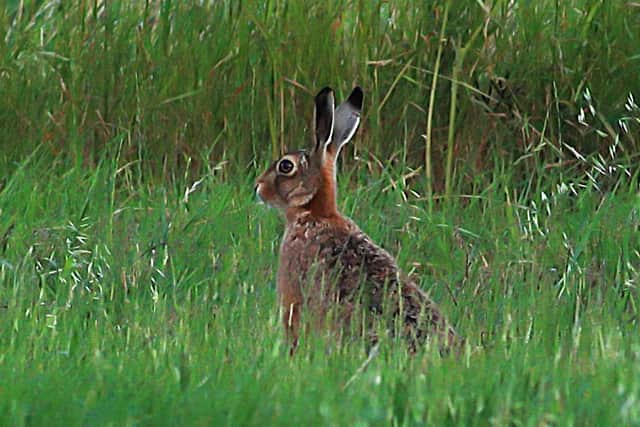

This is not the only surprise when it comes to Brown Hares, mammals which are less common in the uplands around Sheffield than in the low-lying farmlands of Nottinghamshire, Lincolnshire, and South Yorkshire’s Humberhead Levels. Even so, I do occasionally see them down our lane in Norton and spotted my first one some years ago (as a teenager) in nearby Gleadless Valley. Being a species in decline, the Brown Hare is Red Data Book listed, has Biodiversity Action Plans, and yet is not a native species. They were culturally very significant to Celtic peoples who migrated to Britain from central Europe and were later reintroduced to these shores by the Normans in the 1100s. Furthermore, we do have a native species, the Mountain Hare or Irish Hare, which as its name implies, tends to be found in upland regions. On our doorstep in the Peak District, this animal is the symbol of Sheffield’s Sorby Natural History Society. However, although it is native to Britain, the Peak District population became extinct and was introduced to Victorian grouse moors as a game animal, so not native!