
Stock Dove: The beautiful bird often overlooked by twitchers
Although just an occasional visitor to my wildlife garden, this is one of my favourite birds. Whilst its numbers have been increasing, it is still a bird that is often overlooked, unnoticed, and even unidentified, by birdwatchers.
Like the Gadwall Duck I mentioned recently, this is another rather unassuming and unobtrusive bird but one which has a soft and subtle beauty and an ability to remain unnoticed. They look in part like a toned-down version of a Wood Pigeon, but they lack the somewhat mean look of the latter’s eye, the Stocky’s dark eyes and small head giving it a softness and an almost gentle appearance.
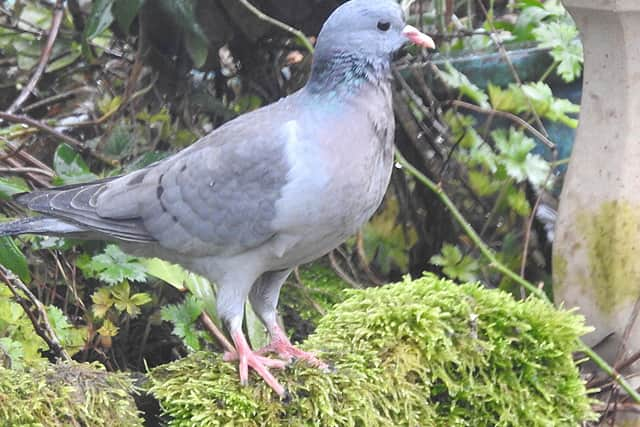

Unlike the obvious plumpness of the Wood Pigeon, these birds are smaller and rather slim, roughly the same size as a Feral Pigeon (the escaped wild version of racing pigeons descended from wild Rock Doves), and similar to the Collared Dove. During the recent rather poor weather we had a couple of Stock Doves visiting, and then, whilst walking in nearby Graves Park, I heard the characteristic ‘coo-roo-oo’ call, described by Cocker and Mabey in ‘Birds Britannica’ as a pumping, throaty coo, but also by some observers as like the sound of a central heating system on a winter’s afternoon, and a comforting background noise rather than a song per se.
Not all ornithologists were so minded however, and the Victorian naturalist and writer, W.H. Hudson, considered it to be the most attractive of all pigeon songs. This call was being delivered quite loudly if rather monotonously from a group of large trees with suitable nesting holes. These birds breed early and so will be on-site and they nest in holes usually in old trees or else in cliff-faces.
The Stock Dove’s tendency to be overlooked is exemplified by the fact that ornithologists did not even recognise it as a British bird until the early nineteenth century. Then, once it was known to be present, it seemed to be spreading across the country, although this perhaps simply reflected the increased tendency of observers to spot and identify it.