
'I’m 24 and I have three kids, you can’t let me die': Sheffield mum's nightmare c-section from rare condition

A Sheffield mum has spoken out after her C-section caused her to haemorrhage and lose more than four litres of blood after having her baby.
Brooke, a mum-of-three from Sheffield, who has chosen not to reveal her surname, suffered the ordeal in March 2022 following a planned C-section at Sheffield’s Jessop Wing maternity unit.
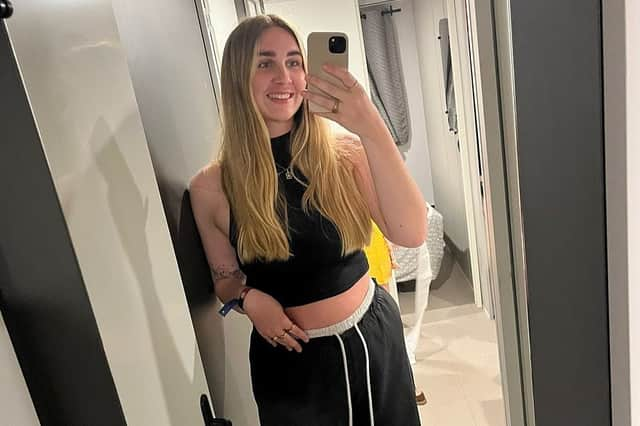

However, hours after returning home in a poorly state, Brooke was rushed to hospital again after suffering a haemorrhage in her living room while breastfeeding her new baby.
It was during emergency surgery doctors discovered a section of her placenta had been left behind, causing her to suffer massive blood loss.
Brooke said: “To anyone who has gone through something similar, I would say definitely speak out about it, even though it is hard and it is painful.
“It took me a long time to open up, but sharing what I went through and getting justice has enabled me to start moving forward again.”

‘Agony’
Brooke was taken to theatre for her C-section in March 2022, and a healthy baby was delivered at 09.28am.
However, Brooke lost more than a litre of blood during the surgery, and further complications arose due to her history of Uterine Didelphys – a condition which causes the formation of two separate uteruses.
“The surgeon said he wasn’t concerned, and that they would just monitor me on the ward,” she added.
However, it was later found Brooke had an additional undiagnosed condition called placenta accreta, causing a piece of her placenta to embed itself in uterine wall, which was missed during the procedure.
After an overnight stay at the hospital, Brooke was sent home. Despite suffering from prolonged heavy bleeding, she was led to believe this was normal.
Shortly after being discharged from care, Brooke’s condition significantly worsened, and she suffered a haemorrhage in her living room whilst breastfeeding her baby.
She was rushed to hospital, where she haemorrhaged three more times, losing two more litres of blood and undergoing emergency surgery.
An ultrasound scan found a large piece of her placenta had indeed been left behind after she had given birth.
“I remember the anaesthetist came to see me before the surgery and I said to them, ‘I’m 24 and I have three kids, you can’t let me die’,” Brooke recounted emotionally.
“They did the surgery but they still couldn’t get all of my placenta out. They filled my uterus with water and packing to stop any more bleeding. I woke up after the procedure in agony.”
Brooke’s ordeal was not over. After another three days, she was sent home, where a visiting midwife failed to notice her high temperature. She was later re-admitted to hospital suffering from an infection.
She complained to bosses at Sheffield Teaching Hospitals NHS Foundation Trust, who said they had internally investigated the matter and found no fault with their conduct.
“I broke down crying,” Brooke recalled. “They said they would look into it properly but they never did.”
Since the traumatic episode, Brooke has struggled with PTSD and post-natal depression, and for a year couldn’t discuss her experience without breaking down.
She added: “It took a massive toll on my relationship with my partner, and we’re not together anymore.
“For a long time I couldn’t go out without someone being near me because I was so afraid of bleeding in public.”
“I lost four whole litres of blood. I could have suffered brain damage. My children could have been without a mum.”
Brooke sought legal assistance from Veritas Solicitors, based in Manchester, and her case against Sheffield Teaching Hospitals NHS Foundation Trust was settled in May for an undisclosed sum.
“Having to relive that time hasn’t been easy, but I wanted justice for what I went through”, she said.
“I had different meetings with consultants and therapists through Veritas to discuss my case, and it was clear from the start that we had a successful case to take forward. It was such a relief to know that.”
Amina Ali, Partner and Head of Clinical Negligence for Veritas Solicitors added: “We are pleased that our client has received a positive outcome after the horror of what she experienced.
“Clinicians and other medical staff have a duty of care towards their patients. When this is neglected, the outcomes can be severe, and this case is a prime example.
“We will continue to champion the rights of people who have suffered unfair or neglectful treatment at the hands of our health service and will always endeavour to get them the justice they deserve.”
Brooke added: “To anyone who has gone through something similar, I would say definitely speak out about it, even though it is hard and it is painful.
“It took me a long time to open up, but sharing what I went through and getting justice has enabled me to start moving forward again.”
Sarah Jenkins, Deputy Medical Director for Sheffield Teaching Hospitals NHS Foundation Trust, said: “During Brooke’s delivery it was discovered that she had placenta accreta and sadly what she experienced during and after childbirth were recognised complications associated with this rare condition.
“It is an incredibly complicated condition to manage, and we are very sorry that despite the best efforts of our team a piece of placental tissue remained in her womb.
“This tissue was subsequently removed and a procedure undertaken to manage the bleeding. The care provided was independently reviewed and no failings in care were identified but we do understand how distressing such a complex and complicated birth can be.”
Maternity services in Sheffield have undergone major changes since a report by NHS inspectors several years ago that said they required improvement.
A Care Quality Commission report made after an inspection in September 2022, said that services at the Jessop Wing required improvement, an upgrade on a previous rating of inadequate in 2021.
Since then, improvements have included better assessment and monitoring of patients and higher standards of staff training and leadership.
One improvement described in 2023 was that 90 per cent of women were seen within 15 minutes or less after their arrival and women are risk assessed at least twice a day. That led to a decrease in complaints.