
University of Sheffield students take a lead on the world’s first Dysarthria Awareness Day
Students at the University of Sheffield have launched the world's first Dysarthria Awareness Day, to raise awareness of the challenging condition.
Dysarthria is the medical term for difficulty with the physical production of speech, often due to muscle weakness. People of all ages can have dysarthria for a wide variety of reasons. One of the main symptoms is unclear speech, which means it can be difficult to understand what people are saying.
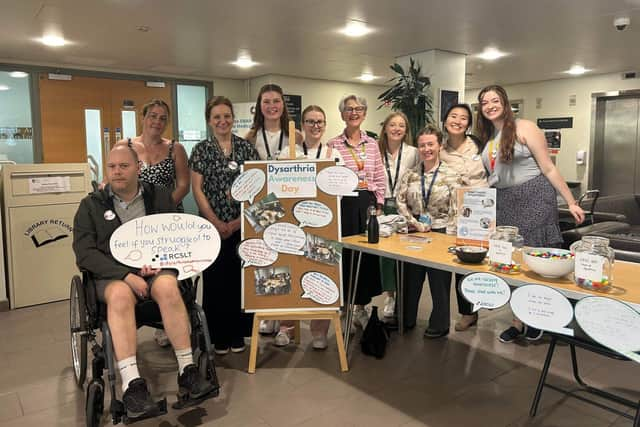
The campaign, led by student Speech and Language Therapists and clients from the Dysarthria Clinic in the School of Allied Health Professions, Nursing and Midwifery, was supported by the Royal College of Speech and Language Therapists, Giving Voice campaign, which aims to ‘give voice’ to people with communication needs.Students and their course leasers organised stands to share information and educate others on the condition.
Ellie Jenkins, 2nd year Masters student, said: “There's awareness month for strokes, there's an awareness month for swallowing but we found out that there's nothing specifically for dysarthria.

“We are starting this today but we are hoping it can spread and continue.”
At the event there were stands and boards with information explaining the condition and ways to help support people, such as listening actively, and giving people more time to speak.
John Quinn, a client from the Dysarthria Clinic, said: “It’s a great idea, a lot of people don’t know about it.
“People definitely treat me differently.”
The students set up two jars for people to fill with pompoms to indicate whether they had or had not heard of the condition. They found that the majority of people had not heard of dysarthria, some of whom were health care staff and students who regularly actively interact with people with dysarthria.
Dr Catherine Tattersall, a University Teacher, said: “It’s one of the most widely experienced communication disorders.
“It affects such a wide range of people but nobody knows the word.”
Dr Caroline Haw, another University Teacher, added: “We want people to use the word so it becomes more familiar to everyone, both in healthcare settings and in society in general.
“Clients told us that many assumptions and judgements are made about people with dysarthria, that they aren’t intelligent or don’t understand things, but this is not the case.”
Lucy Anderson, a Masters student, said: “Communication doesn’t equal intelligence. Your communication doesn't define you as a person."
The students and staff hope this will become an annual event to continue raising awareness.