
New research shows that one in five UK adults are concerned about sexual harassment in the workplace
One year on from the introduction of the Worker Protection Act, new research from online training provider High Speed Training has revealed that one in five UK adults are actively concerned about sexual harassment in the workplace [1], with one in ten reporting they had witnessed behaviour they considered to be sexual harassment at work.
The Worker Protection Act (2023) which came into force in October 2024, introduced a legal duty for employers to take "reasonable steps" to prevent the sexual harassment of their employees. The legislation put the onus on the employer - rather than the employee - to take action against inappropriate conduct which would fall under the category of sexual harassment in the workplace. It also gives workers more protection, rights and support should they experience any kind of sexual harassment when at work.
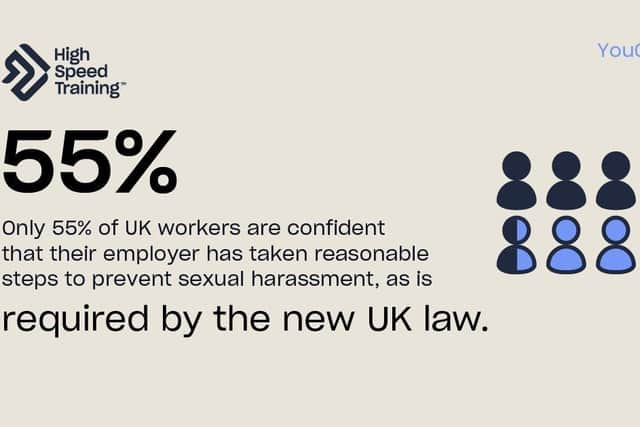
However, a YouGov survey from High Speed Training, a leading e-learning provider based in Ilkley, found that only 55% of UK workers are confident that employers have taken these reasonable steps. The survey of over 2,200 UK adults also found that 10% of UK workers say they have witnessed behaviour at workplaces in the last 12 months that they would consider to be sexual harassment, as well as finding that only 62 percent of UK workers feel confident that workplaces would handle a report of sexual harassment effectively
Dr Richard Anderson, head of learning and development at High Speed Training, said: “The term ‘sexual harassment’ refers to any sort of unwanted conduct of a sexual nature that has this effect. Anybody who experiences unwanted sexual behaviour, whether this be verbal, physical or digital, is a victim of sexual harassment.”


Examples of this behaviour are:
- Comments, ‘jokes’, inappropriate remarks, emails, messages or questions of a sexual nature.
- Sexual propositions or bribes, such as offering to help a colleague at work in return for going out for a drink or on a date.
- Posting inappropriate comments on social media, such as commenting about a person’s appearance in a picture they’ve shared.
- Inappropriate hand gestures or facial expressions.
- Unwanted physical contact, including touching, hugging, unwelcome sexual advances and all forms of sexual assault.
High Speed Training’s research also found stark differences across generational demographics. Respondents to the survey aged 18-24 were more than three times as likely to say they have witnessed behaviour they considered to be sexual harassment at a workplace as those aged 45+ (18% vs 5%).
The figures suggest that younger employees are either being disproportionately exposed to or witnessing sexual harassment, or, as employees joining the workforce in a post #MeToo era, are more adept at recognising inappropriate behaviour.

Younger workers may also be more likely to occupy more junior or entry-level positions, which could make them more vulnerable to inappropriate conduct, and feel less empowered to challenge it.
Dr Anderson said: “A year on from the introduction of the new Worker Protection Act, our research has shown that there is still lots of work to be done.
“If we expand our findings to the whole of the UK workforce, which the ONS estimated to be 36.9 million people in December 2024, these findings would suggest that nearly 3 million people have witnessed sexual harassment in the workplace in the last 12 months, underlining the need for the new legislation, and showing just how much work employers need to do to ensure that everyone feels safe and supported at work.
“A strong workplace culture, one that promotes transparency, trust and inclusivity, is built by visible and consistent action and investment. For organisations looking to demonstrate their commitment, comprehensive sexual harassment training is a great place to start.”
Thousands of UK businesses are already recognising this. Since the WPA came into force 12 months ago, High Speed Training has seen more than a 1,500% increase in companies enrolling teams on its Sexual Harassment Training for employees course, with a 2,234% increase in uptake of their Sexual Harassment Training for managers course.
To find out more, visit High Speed Training to read the whole report.
[1] All survey figures, unless otherwise stated, are from YouGov Plc. Total sample size was 2208 adults. Fieldwork was undertaken between 29th to 30th September 2025. The survey was carried out online. The figures have been weighted and are representative of all UK adults (aged 18+).