
REVIEW: Death on the Nile at the Lyceum, Sheffield
Mother’s Day is coming up – and here’s a show for mummies everywhere (though there are regrettably few other Egyptian allusions in Death on the Nile).
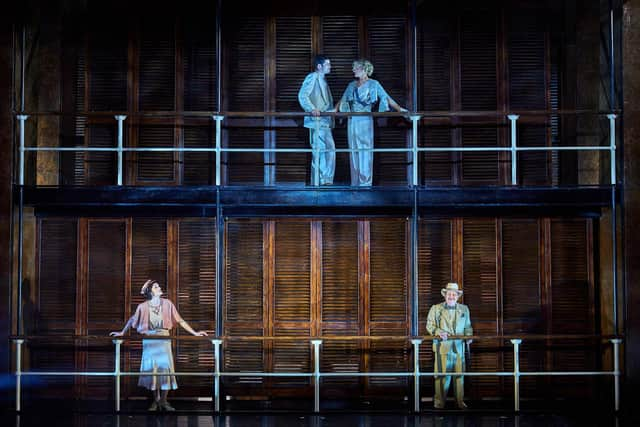
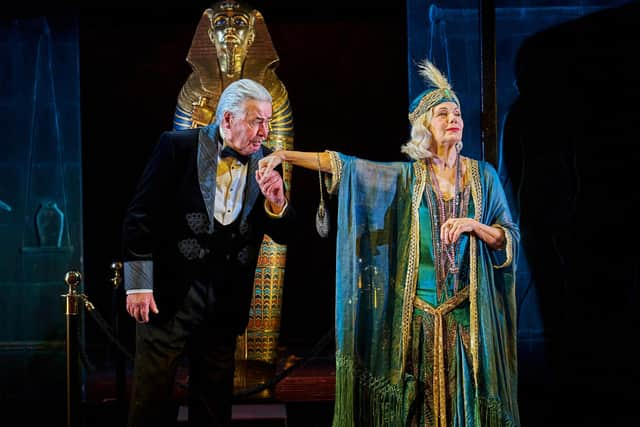
There’s a sarcophagus, yes, and some imposing stone tableaux among the ancient exhibits in the British Museum, but a palm tree here, a pyramid there, perhaps the golden glow of a baking sun, wouldn’t have gone amiss in an otherwise dark and gloomy stage set that relies heavily on imagination.

But there is death to lighten the tone! More than one! And everybody’s favourite diminutive detective, Hercule Poirot, ooh-la-la-ing liberally, twiddling the waxed tips of his curled moustache profusely, as he works to decode the time-bending MO of a murder like Belgium’s answer to the Rosetta Stone.
“Have a good time – or you may be prosecuted,” comes his announcement before the show, in something akin to that distinctive accent, and the scene is set for a stylish production laced with affectionate, if somewhat overdone, sending-up of the Christie trope.
Mark Hadfield plays a knowing Poirot, fully fourth-wall-aware of his own fame and fiction. Though he begins by describing the case as being ‘as close to the heart of evil as I’ve ever come’, a distinctly un-evil comic ribbing runs throughout the show.
“Your William Shakespeare was good – but he was no Agatha Christie,” Poirot informs an English passenger aboard the SS Karnak, with a winked aside to the audience.
“Wherever you go, a dead body turns up,” quips Poirot’s amiable sidekick – Holby City’s Bob Barrett, back again in a Christie on the Lyceum stage after his turn in Murder on the Orient Express last year.
Last time he was Poirot’s good friend and genial director of the train company. This time he’s Poirot’s good friend and genial Colonel Race, serving the same purpose as a foil for Poirot’s idiosyncrasies.
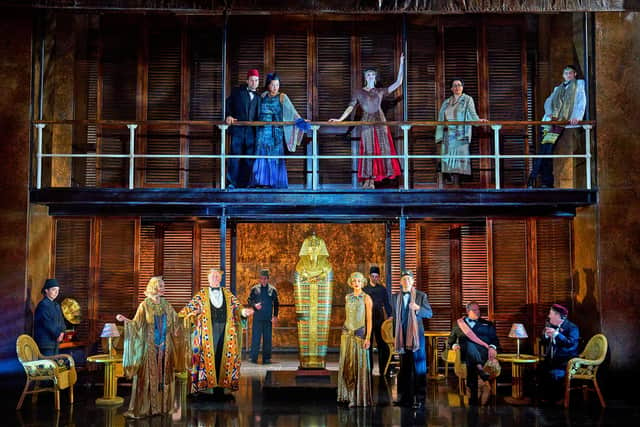
As the dastardly deeds reach their denouement, Race laments: “This is the part where all the passengers are assembled – I hate this part.” “I love this part!” exclaims Poirot gleefully.
This new adaptation and European premiere of Agatha Christie’s 89-year-old classic follows a sell-out tour of Murder on the Orient Express, and reunites writer Ken Ludwig, designer Mike Britton and acclaimed director Lucy Bailey.
But there are a few directorial touches which don’t quite land: dreamlike ultra-slow hand-clapping is deployed to indicate a sense of foreboding and time standing still – but just comes across as strange.
And there are some ludicrous moments, too. Who, for example, when faced with the quandary of an heiress trapped inside a priceless ancient sarcophagus, would suggest blasting it open with a pistol, when surely a simple butter knife would be better?
There were a few fluffed lines on opening night, and some quick-thinking ad-libbing when a dropped prop clattered loudly to the stage, causing Colonel Race to jump out of his skin. “The place is falling apart!” quipped Poirot, his leetle grey cells working overtime.
But, slips aside, this is a classy retelling.
As so often with Agatha Christie, the second half is better than the first – once the passenger manifest of characters has been introduced, the murder committed, the motives begin to build and the whodunnit can pick up pace.
Mike Britton’s set is less ingenious than his stunningly memorable Orient Express scenery, but is shifted and rearranged with balletic flourish.
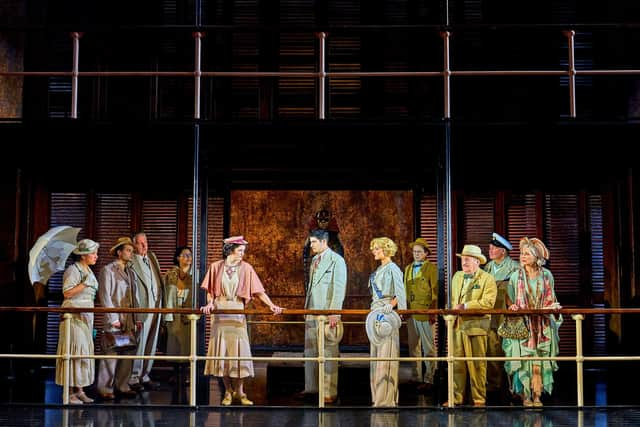
The full-height split-level staging, with its sliding teak panels and galleried deck, is effective as the vintage paddle steamer cruising down the Nile.
Libby Alexandra-Cooper, as enigmatic as a Tamara de Lempicka painting, makes a striking professional debut as Linnet.
And the costumes – glittering garb to match the characters’ gilded lives – are sumptuously beautiful, especially those of Linnet and Salome (Glynis Barber, famous as Makepeace in Dempsey and Makepeace, and Glenda Mitchell in EastEnders).
- Death on the Nile is at the Lyceum, Sheffield, till Saturday, March 14.