
Author, Emily Shore, encourages children to get creative in 2026
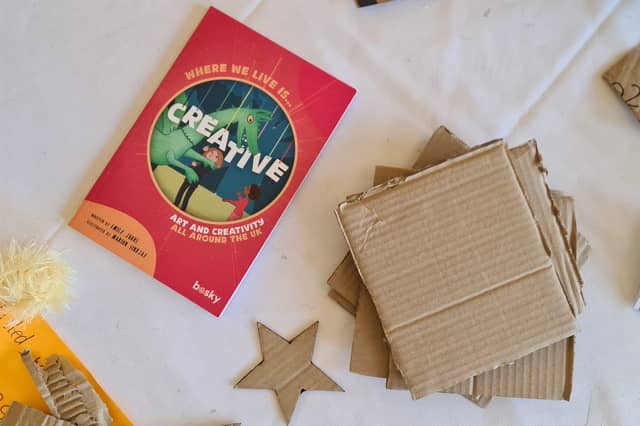

A new children’s book featuring Yorkshire landscape artist, James Brunt, and Fieldhead Hospital’s labyrinth in Wakefield, has recently been published in the UK.
There is much evidence that the UK is a wonderfully creative place. If you search on the ‘Discover’ section of Art UK’s website, you will find over 69,000 sculptures listed across the four nations of the UK. According to www.ukhandknitting.com, crafting (including knitting and crochet) contributes £3.4 billion to the UK economy (citing the Crafts Council, 2014). And more than 9/10 adults engaged with the arts at least once in the year between April 2024 and March 2025. But there are some challenges when we look at the opportunities for creativity for children (and specifically within education).
Why is creativity important for children? What are the benefits?
Many people recognise the value of creativity in all walks of life, contributing positively to the economy, to entrepreneurship and to wellbeing (as highlighted in the report Durham Commission for Creativity in Education).

“Participation in cultural and creative activities has been shown to improve wellbeing (Conner et al., 2018; Fujiwara et al. 2014; Marsh et al. 2010), and there is mounting evidence that creativity and the arts can make a significant difference to people’s health and wellbeing, as well as to how they feel about, and interact with, their neighbours (Ings et al., 2010).”
Durham Commission for Creativity in Education, page 40
“The Time to Listen (TALE) project demonstrated that young people feel that engagement with the arts promotes a sense of personal wellbeing. Nearly half of young people surveyed (45%) say that the arts help them relax and reduce stress. This is particularly the case for young women (53%) and for sixth form students (49%).”
Durham Commission for Creativity in Education, page 42
So what are the challenges for young people and children in the UK?
In the article ‘Redefining classical inside the ‘bold and creative’ BBC Proms of today’, Sam Jackson is quoted as saying that “since 2010, the uptake in GCSE Music has fallen by 36%”. The Cultural Learning Alliance’s 2025 Report Card also notes that there has been a 42% fall in Expressive Arts GCSE entries since 2010, and only 6.6% of GCSE entries in the most deprived areas are in arts subjects, compared to 8.3% in the most affluent – this doesn’t suggest a level playing field where the arts are concerned. In fact, the CLA Report card says that “working class young people are four times less likely to work in the creative industries”. (www.culturallearningalliance.org.uk)
Featuring artworks and experiences from across the UK, Where We Live is Creative offers a window into the breadth and depth of creativity that exists throughout our communities. The book, aimed at families with children between the ages of 5 and 8, celebrates a wide-ranging spectrum of creativity, artists, organisations and creative expressions in less formal settings – outside of art galleries. Author, Emily Shore, introduces five categories of creative expression: performance, festivals, makers, art outside, and creative journeys, with each chapter featuring stunning illustrations by Marion Lindsay.
Emily says, “The creative and collaborative journey of putting this book together has brought me so much life and joy, personally, and I hope it does the same for families as they explore the different themes and try out the various activities together at home. I believe in the power of creativity to inspire us and to heal us, and the aim of the book is to encourage every child that they were born to be creative – whatever that looks like. The world needs what they have! When we all feel able to express our uniqueness in a creative way, and to share it, it makes the whole world more beautiful and more colourful; kinder and more hopeful.”
Macro and micro creativity
Each of the themes has been chosen because it can be accessed by children easily at home, or it can be a larger scale production, event or artwork that can be found around the UK.
Educational publisher, Heather Sargeant, says, “Children are so creative at this age. Whether it is making up their own performances or songs at home or being inspired to give arts and crafts a go, or even more mainstream creative toys like being creative with building blocks. The aim of the book is to share and open up new types of creativity so that families can talk about the joy that comes through being creative. I grew up in a musical family where my aunty always had crafts ready for us to try, and my mum showed me how to sew and knit. Being creative brings so many of us a lot of joy and Emily’s writing and Marion’s illustrations really do invite families to find the creativity in their own communities.”
‘Where we live is creative’
Published Wednesday December 17, 2025
ISBN: 9781739450441
Bosky Publishing www.boskypublishing.com